Advanced Training for the Pembroke Welsh Corgi

- Advanced Training for the Pembroke Welsh Corgi
- Understanding Your Corgi's Learning Style
- Building Focus and Impulse Control
- The "Leave It" Progression
- Agility Training for Short Legs and Big Brains
- Common Agility Challenges
- Scent Work and Nose Games
- Building a Reliable Alert
- Trick Training and Task Work
- Addressing Herding Behavior in Advanced Training
- Controlling the Nip
- Distance Work and Off-Leash Reliability
- Maintaining Motivation and Preventing Burnout
- Taking Training Beyond the Backyard
- Conclusion: Unlocking Your Pembroke Welsh Corgi's Potential
- Related Articles
- Frequently Asked Questions
- At what age can I start advanced training with my Pembroke Welsh Corgi?
- How do I handle my Corgi's stubborn streak during advanced training?
- Can Pembroke Welsh Corgis do the same agility work as other breeds?
- How much daily training does an advanced Corgi need?
- What's the best advanced activity for a Corgi who gets bored easily?
Advanced Training for the Pembroke Welsh Corgi
Your Corgi just herded the cat, outsmarted the treat puzzle in forty-three seconds flat, and is now staring at you with those intelligent eyes that clearly say, “What’s next?” If you’ve already conquered sit, stay, and recall, you’ve probably noticed something: your Pembroke Welsh Corgi gets bored faster than most dogs. That’s because behind that adorable face sits a working dog bred to move livestock with split-second decisions and relentless focus. Basic obedience barely scratches the surface of what this breed can accomplish.
Advanced training isn’t just about teaching flashy tricks. It’s about channeling that herding instinct, satisfying an intellect that demands mental challenges, and preventing the destructive behaviors that emerge when a Corgi’s brain isn’t sufficiently engaged. The good news? These dogs were bred to work independently and problem-solve, which makes them exceptional candidates for complex training—once you understand how to work with their stubborn streak rather than against it.
Understanding Your Corgi’s Learning Style
Pembrokes learn differently than Golden Retrievers or Border Collies, and pretending otherwise will frustrate both of you. These dogs were bred to herd cattle by nipping at heels, darting away from kicks, and making quick decisions without constant handler input. That independent thinking translates to a dog who’ll question why they should perform a behavior if they don’t see the point.
The mistake most owners make is repeating commands. Say “down” once and wait. Your Corgi heard you the first time—they’re just deciding whether compliance serves their interests. Repeating commands teaches them to ignore you until the fifth or sixth repetition. Instead, use a ten-second rule: give the command once, wait ten seconds, then either reward the behavior or remove the reward opportunity and try again in a few minutes.
Motivation matters enormously with this breed. While some Corgis work enthusiastically for kibble, most need high-value rewards for advanced work. Think tiny pieces of chicken, freeze-dried liver, or cheese. Rotate rewards unpredictably—sometimes they get the jackpot treat, sometimes just praise, sometimes a quick game with a favorite toy. This variable reinforcement schedule keeps them guessing and engaged far longer than predictable rewards.
Building Focus and Impulse Control
Before tackling complex behaviors, you need rock-solid attention. Corgis have a herding dog’s environmental awareness, meaning every squirrel, leaf, and passing dog registers as potentially worthy of their attention. Advanced work requires the ability to maintain focus despite distractions.
Start with the “watch me” command in a boring environment. Hold a treat between your eyes, say “watch me,” and reward eye contact that lasts three seconds. Gradually increase duration to thirty seconds, then add mild distractions—a toy on the ground, another person walking by, food placed nearby. The goal is building a conditioned response where your Corgi automatically checks in with you when uncertain or overstimulated.
The “Leave It” Progression
Impulse control exercises prevent the nipping, chasing, and obsessive behaviors that plague undertrained herding dogs. The “leave it” command becomes your foundation for everything from polite greetings to advanced scent work.
Begin with a treat in your closed fist. Your Corgi will lick, paw, and nibble at your hand. The instant they back off—even just turning their head—mark it with “yes” and reward from your other hand. Practice until they immediately move away from your closed fist. Next, place a treat on the floor with your hand hovering over it, ready to cover it if they lunge. Reward backing away. Finally, practice with treats on the ground while you’re standing upright, rewarding your dog for making eye contact with you instead of grabbing the food.
Once mastered, this transfers to leaving the cat alone, ignoring food on counters, and resisting the urge to herd running children—all common Corgi challenges.
Agility Training for Short Legs and Big Brains
Despite their stumpy legs, Pembrokes excel at agility when courses are adjusted for their unique build. They’re fast, nimble, and love the problem-solving aspect of navigating obstacles. Many Corgis compete successfully in the 8-inch and 12-inch jump height divisions.
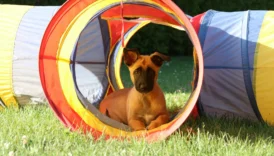
Start with basic obstacles at home or in a class environment. Tunnels are natural favorites—most Corgis charge through without hesitation. Weave poles require more patience but capitalize on their lateral agility. The key adjustment is jump height. While standard courses use 16-24 inch jumps for medium dogs, your Corgi should jump no higher than one-and-a-half times their height at the shoulder, typically 8-12 inches for adults.
The A-frame and dog walk need extra attention. That long spine and short legs create unique physical stresses. Teach a solid two-on-two-off contact behavior, where your dog stops with front paws on the ground and rear paws still on the obstacle. This ensures safe dismounts and prevents the back injuries that plague Corgis who repeatedly jump from heights.
Common Agility Challenges
Corgis often develop the “zoomies” mid-course, breaking from the sequence to do victory laps. Combat this by practicing impulse control between obstacles—requiring a sit or down before releasing to the next challenge. Make the work itself rewarding rather than just the completion.
Another issue is selective hearing during high excitement. Your normally obedient dog might ignore “come” when the tunnel beckons. Train directional commands (“left,” “right,” “tunnel,” “jump”) in low-distraction environments first, gradually adding excitement only when the verbal cues are solid.
Scent Work and Nose Games
Corgis possess roughly 220 million scent receptors and a herding dog’s natural tracking ability. Scent work provides incredible mental stimulation—fifteen minutes of nose work tires a Corgi as much as an hour-long walk.
Start with simple scent discrimination. Take three identical boxes, place a treat in one, and let your dog investigate. Mark and reward when they indicate the correct box with a paw touch, nose bump, or sit. Once they understand the game, introduce a target scent. Essential oils like birch, anise, or clove work well. Place a cotton ball with one drop of oil in a small container, hide it in easy locations, and reward your dog for finding it.
Progress to harder hides—elevated locations, buried under towels, or hidden in vehicle interiors. Many Corgis advance to competitive nose work trials within six months of starting training. The beauty of scent work is that it’s entirely non-physical, perfect for older dogs or those with mobility issues while still providing intense mental challenge.
Building a Reliable Alert
Teaching your Corgi to indicate finds consistently prevents false alerts. Some dogs naturally sit at the source, others paw or bark. Choose one behavior and reward only that specific indication. If your dog sits near the hide but not at it, withhold the reward and encourage them to pinpoint the exact location. Precision matters in advanced work.
Trick Training and Task Work
Complex trick chains showcase your Corgi’s intelligence while building communication between you. Unlike simple tricks, these involve multiple sequential behaviors performed on a single cue.
Consider teaching “clean up your toys.” Break it down into components:
- Touch the toy with their nose (mark and reward)
- Pick up the toy in their mouth (mark and reward)
- Hold the toy while moving toward the toy box (mark and reward)
- Drop the toy into or near the box (jackpot reward)
- Chain the behaviors together on the cue “clean up”
Train each step separately until fluent, then combine them. Most Corgis grasp the full sequence within two weeks of daily five-minute sessions. The process teaches them to think through multi-step problems, which transfers to other training contexts.
Other useful task chains include retrieving specific items by name, opening and closing doors, turning lights on with a paw target, or even bringing you items from a list. One owner taught her Corgi to fetch different family members’ shoes—a ten-item discrimination task that took four months but now reliably works on command.
Addressing Herding Behavior in Advanced Training
You can’t eliminate herding instinct, but you can redirect it. Corgis who nip at running children or chase bikes are simply doing what centuries of breeding programmed them to do. Advanced training provides appropriate outlets.
Treibball, also called urban herding, lets your dog push large exercise balls into a goal using their nose and body. It satisfies the herding drive without livestock. Start with one ball, teaching your dog to push it toward you for a reward. Add directional cues (“away,” “come by”) borrowed from sheepherding commands. Competition-level Treibball requires pushing eight balls into a goal within a time limit while responding to distance handling—perfect for the Corgi who wants a job.
If you have access to herding lessons with sheep or ducks, even better. Many Corgis take naturally to stock work, though their low-slung build means they work differently than Border Collies. A good herding instructor understands breed differences and won’t expect your Corgi to perform wide outruns or sustained eye contact.
Controlling the Nip
Heel-nipping requires specific intervention. When your Corgi nips, immediately stop moving, turn away, and ignore them for thirty seconds. Movement triggers the chase-and-nip sequence; stillness removes the reward. Simultaneously, teach an incompatible behavior—holding a toy in their mouth during exciting activities leaves no room for nipping. Many owners keep a small tug toy in their pocket specifically for this purpose.
Distance Work and Off-Leash Reliability
Advanced obedience means your Corgi responds even when you’re fifty feet away in a distracting environment. This level of reliability requires systematic distance and distraction training, not just hoping your dog generalizes.
Start with a thirty-foot long line in a fenced area. Practice basic commands (sit, down, stay, come) at increasing distances, beginning at three feet and adding two feet per session only when your dog responds correctly 90% of the time. If performance drops below 80%, you’ve progressed too quickly—back up a step.
Add distractions methodically. A toy on the ground at twenty feet is easier than a squirrel at ten feet. A person standing still is easier than a person running. Build a hierarchy of your individual dog’s distractions and work through them systematically. Most Corgis find moving objects (bikes, joggers, other dogs) most challenging due to their chase instinct.
Emergency recall deserves special attention. Choose a unique word you’ve never used before—”urgent” or “now” works well. Pair it with the absolute highest-value reward your dog knows. For many Corgis, this means real meat or cheese, not treats. Practice this recall only once or twice weekly to keep it special, and reward extravagantly every single time. This becomes your safety net when regular recall fails.
Maintaining Motivation and Preventing Burnout
Corgis are enthusiastic learners initially, but they’ll check out fast if training becomes repetitive. Keep sessions under ten minutes, ending while your dog still wants more. Train three short sessions daily rather than one long one.
Rotate through skills rather than drilling one behavior endlessly. Practice scent work Monday, agility Tuesday, trick training Wednesday. This variety prevents the glazed-over look that signals mental fatigue. If your Corgi starts offering behaviors slowly, looking away frequently, or lying down mid-session, that’s not stubbornness—it’s burnout. Take a break.
Variable reinforcement schedules keep training interesting. Once a behavior is solid, reward randomly—sometimes the first repetition gets jackpotted, sometimes the fifth, sometimes none in a session but extra play instead. This unpredictability maintains engagement far better than rewarding every single rep.
Taking Training Beyond the Backyard
Advanced skills mean nothing if they only work at home. Generalization—performing behaviors in new locations with new distractions—requires deliberate practice. Your Corgi who’s perfect in the living room might completely forget their training at the park.
Practice in at least ten different locations: friends’ yards, parking lots, pet stores, hiking trails, outdoor cafes. Each new environment requires re-teaching at an easier level initially. If your dog holds a three-minute stay at home, expect only thirty seconds in a new place initially. Build back up gradually.
Group classes provide controlled exposure to other dogs, teaching your Corgi to work despite fascinating distractions. Look for classes specifically labeled “advanced obedience” or “competition prep” rather than basic manners courses. Your dog needs peers at their skill level to stay challenged.
Consider formal activities like Canine Good Citizen Advanced testing, Rally Obedience, or trick dog titles. These provide structure, goals, and external validation of your training progress. Many Corgis thrive on the routine and expectations of working toward certifications.
Conclusion: Unlocking Your Pembroke Welsh Corgi’s Potential
Advanced training transforms your Pembroke Welsh Corgi from a clever pet into a skilled partner. These dogs need work—not just physical exercise, but genuine mental challenges that engage their problem-solving abilities and satisfy their herding heritage. Whether you pursue agility, scent work, task training, or all of the above, the key is consistency, appropriate motivation, and respect for their independent thinking style.
The most successful Corgi trainers view their dogs as collaborators rather than subordinates. Yes, you set the rules and provide structure, but within that framework, your dog’s intelligence deserves acknowledgment. Challenge that bright mind regularly, keep sessions positive and varied, and you’ll discover capabilities you didn’t know your short-legged companion possessed.
Start with one new skill this week. Maybe it’s building a more reliable distance down, or introducing your first scent discrimination game, or teaching the first component of a trick chain. Your Corgi is ready for more—the question is whether you’re ready to provide it.
Related Articles
- Advanced Training for Great Pyrenees: Master Their Independence
- Anatolian Shepherd Advanced Training: A Complete Guide
- Advanced Training for Great Danes: Building a Gentle Giant
- Advanced Training Strategies for Different Dog Breeds
- Advanced Training Techniques for Your Cocker Spaniel
Frequently Asked Questions
At what age can I start advanced training with my Pembroke Welsh Corgi?
Most Corgis are ready for advanced work around 12-18 months old, once basic obedience is solid and their attention span has matured. However, you can introduce foundation skills like impulse control and scent games as early as 4-6 months. The key is matching training intensity to your individual dog’s physical and mental development, not rushing into complex sequences before they’re ready.
How do I handle my Corgi’s stubborn streak during advanced training?
Corgi “stubbornness” usually signals unclear communication, insufficient motivation, or boredom. Make sure your dog truly understands what you’re asking by breaking behaviors into smaller steps. Use higher-value rewards for difficult tasks, and keep sessions short enough that your dog stays engaged. If your Corgi consistently refuses a known behavior, check for physical discomfort—their long backs and short legs can make certain positions painful.
Can Pembroke Welsh Corgis do the same agility work as other breeds?
Yes, but with modifications for their build. Corgis compete successfully in agility trials using lower jump heights (typically 8-12 inches) and need careful attention to contact obstacles to protect their spines. They’re fast and nimble but shouldn’t attempt the same jump heights or sharp turns that larger, differently proportioned breeds handle easily. Many organizations offer divisions specifically for small or low-stationed dogs.
How much daily training does an advanced Corgi need?
Three 5-10 minute training sessions daily provide excellent mental stimulation without causing burnout. This totals just 15-30 minutes of focused work, which is far more effective than hour-long sessions. Additionally, incorporate training into daily life—practicing stays during meal prep, recalls during walks, or impulse control when greeting visitors. This distributed practice builds reliability better than isolated training sessions.
What’s the best advanced activity for a Corgi who gets bored easily?
Scent work typically captivates even the most distractible Corgis because it leverages their natural tracking instincts and provides intense mental challenge. Unlike obedience work, which can feel repetitive, each scent hide presents a new puzzle. Many owners report that Corgis who barely tolerate regular training become completely focused during nose work sessions. The low physical impact also makes it suitable for dogs of any age or fitness level.