Advanced Training for Bloodhounds: A Complete Guide
- Advanced Training for Bloodhounds: A Complete Guide
- Understanding the Bloodhound Mind Before Advanced Work
- Building Bulletproof Recall in a Scent-Driven World
- The High-Value Hierarchy
- Proofing Against Real-World Scents
- Advanced Scent Work and Tracking Progression
- Moving Beyond Basic Trail Following
- Cross-Track Contamination
- Managing Prey Drive and Environmental Distractions
- Off-Leash Reliability and Distance Control
- Public Access Training and Loose-Leash Walking
- The Permission Protocol
- Duration and Distance Building
- Problem-Solving Common Advanced Training Challenges
- The Shutdown Response
- Selective Hearing
- Maintaining Skills and Preventing Regression
- Your Path Forward with Advanced Bloodhound Training
- Related Articles
- Frequently Asked Questions
- How long does it take to fully train a bloodhound in advanced skills?
- Can bloodhounds ever be trusted off-leash in unfenced areas?
- Why does my bloodhound ignore commands when tracking a scent?
- What's the best age to start advanced training with bloodhounds?
- How do I stop my bloodhound from pulling on the leash during walks?
Advanced Training for Bloodhounds: A Complete Guide
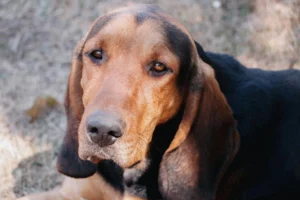
Your bloodhound freezes mid-walk, nose plastered to the ground. That determined body goes rigid, tail flagging like a metronome, and suddenly you’re being dragged toward a fence line where a rabbit passed through twenty minutes ago. The leash burns your palm as 110 pounds of single-minded determination overrides every “leave it” command you’ve practiced. If you’ve owned one of these magnificent scent hounds for more than a week, you know the unique challenge they present. Their noses weren’t just designed to follow trails—they were engineered to obsess over them, tuning out distractions (including you) with impressive dedication.
Training bloodhounds at an advanced level requires understanding that you’re working with a dog whose primary sense operates in a dimension humans can barely comprehend. They detect scent particles at concentrations of one part per trillion. That’s not a training obstacle—it’s your greatest training asset once you learn to channel it properly.
Understanding the Bloodhound Mind Before Advanced Work
Before diving into complex exercises, you need to accept a fundamental truth: bloodhounds weren’t bred for obedience. They were bred for independent decision-making on the trail. A tracking dog working a scent trail 400 yards ahead of its handler can’t stop to ask for permission at every turn. This independence, wired into their genetics after centuries of selective breeding, means your training approach must differ radically from what works with shepherd breeds or retrievers.
These hounds think in scent pictures. While you’re seeing a park with benches and trees, your bloodhound is reading an olfactory timeline—who walked here, when they walked, where they touched, what they carried. This cognitive difference means traditional corrections often fail. Yanking the leash while your dog processes a fascinating scent story doesn’t teach restraint; it just adds confusion and frustration to an already complex mental task.
Success with advanced training starts when you position yourself as the gateway to what they want most: permission to use that extraordinary nose. Every advanced skill you’ll build—off-leash reliability, public access manners, advanced tracking—rests on this exchange. They get to work; you get responsiveness and control.
Building Bulletproof Recall in a Scent-Driven World
Teaching a reliable recall to a bloodhound ranks among the most challenging tasks in dog training. You’re asking them to abandon the very instinct that defines their existence. A half-hearted approach produces half-hearted results, so you’ll need to make coming back to you more rewarding than following that deer trail into the woods.
The High-Value Hierarchy
Start by identifying your dog’s currency. For most bloodhounds, food tops the list, but not just any food. You need something that makes their eyes go wide—real meat, cheese, or freeze-dried liver. Test five different treats in a controlled environment and note which one produces the most enthusiastic response. That’s your recall treat, and it appears only during recall training. Never for basic sits or downs. This treat means one thing: emergency stop everything.
Begin in a enclosed space with zero distractions. Call your dog from three feet away using a distinct recall word—not “come” if you’ve already poisoned that cue with inconsistent enforcement. Many trainers use “here” or “front.” The moment your dog moves toward you, mark it with a clicker or “yes,” then deliver three pieces of that premium treat in rapid succession. Not one. Three. You’re creating a jackpot moment that interrupts their scent processing.
Proofing Against Real-World Scents
After two weeks of short-distance recalls with 100% success rate, introduce mild distractions. Drag a hot dog on a string across the ground, let your bloodhound sniff it for exactly two seconds, then call the recall. If they turn away from the scent trail to return to you, you’ve achieved something remarkable. Celebrate with five treats and genuine enthusiasm.
Gradually increase difficulty over 4-6 months. Practice recalls when your dog is investigating bushes, when other dogs are visible (but at distance), and eventually during walks when they’re tracking something interesting. Never call a recall you can’t enforce. If your bloodhound is locked onto a scent trail and you’re 90% sure they’ll ignore you, don’t call it. Wait for a natural break in their focus, then practice.
Advanced Scent Work and Tracking Progression
Since your bloodhound already lives for scent work, advanced tracking training feels less like obedience and more like giving them a doctorate in their chosen field. This training builds confidence, provides mental exhaustion that physical exercise alone can’t match, and channels their drive into structured work.
Moving Beyond Basic Trail Following
If your dog can already follow a simple track you laid ten minutes ago, it’s time to increase complexity. Age your tracks progressively—start with 30-minute-old trails, then 60 minutes, working up to tracks that are 3-4 hours old. The scent becomes fainter and more challenging to follow, requiring deeper concentration.
Introduce turns and direction changes. Walk in a straight line for 50 yards, make a 90-degree turn, continue another 50 yards. Mark your turns with flags initially so you know where your dog should change direction. When they work through that turn without hesitation, keeping their nose down and committing to the new line, they’re demonstrating genuine tracking skill rather than just following the easiest scent path.
Cross-Track Contamination
Real-world tracking rarely involves a single undisturbed trail. Create training scenarios where you or a helper crosses the original track perpendicularly. Your bloodhound needs to learn to distinguish the “correct” track from contamination. They should indicate momentary confusion—head up, circling—then relocate the original line.
This skill takes months to develop reliably. Start with obvious differences: have the track layer wear one type of shoe and the contaminator wear different shoes. Use treats or toys to reward your dog for committing back to the original track after encountering the cross-track. Over time, make the contamination more challenging by using similar scents or having multiple people cross the track at different points.
Managing Prey Drive and Environmental Distractions
Bloodhounds don’t have the explosive prey drive of sighthounds, but they’ll absolutely lock onto and follow wildlife scent trails with impressive determination. Advanced training means teaching them to acknowledge distractions without completely surrendering to them.
The “check-in” behavior becomes your foundation here. Every time your bloodhound is investigating something fascinating and voluntarily glances back at you—even for a split second—mark and reward it immediately. You’re reinforcing the concept that staying loosely connected to you, even while working scent, pays dividends.
Practice the “leave it” cue with progressively more challenging scenarios. Start with dropped food, advance to food scattered in grass, then to animal scent (rabbit fur, deer scent, etc.). The goal isn’t to shut down their nose—that’s impossible and unfair. The goal is to install a pause button. When you say “leave it,” your bloodhound should freeze for 3-5 seconds and look to you for permission before resuming investigation. That pause gives you time to assess whether they’re tracking toward a busy road, a neighbor’s yard, or somewhere safe to continue.
Off-Leash Reliability and Distance Control
True off-leash reliability with a bloodhound is rare, and frankly, most don’t achieve it. Their scenting drive simply overrides handler connection when a compelling trail appears. However, you can develop reliable off-leash work in controlled environments—fenced areas, tracking fields, or during structured training sessions.
Start with a long line (30-50 feet) rather than going immediately off-leash. This gives the illusion of freedom while maintaining safety. Practice all your basic commands—sit, down, stay, heel—with the long line dragging. Your bloodhound learns to respond even without feeling leash pressure.
Introduce the emergency down. This is distinct from a regular down command. It means “drop immediately regardless of what you’re doing.” Train this indoors first with high-value rewards, then practice outdoors in gradually more distracting environments. The emergency down can prevent your dog from running toward danger when off-leash work goes sideways.
Use a three-stage progression for off-leash work:
- Fenced area with mild distractions (other dogs at distance, scattered toys)
- Fenced area with moderate distractions (people playing, food on ground, wildlife scent trails)
- Controlled outdoor spaces with long line backup (hiking trails, large parks during quiet hours)
Most bloodhound owners find that true off-leash work remains situational. Your dog might be perfectly reliable in your five-acre property but completely unreliable in unfamiliar territory. Accept this reality rather than pushing beyond your dog’s capability and risking their safety.
Public Access Training and Loose-Leash Walking
Getting a bloodhound to walk politely through a farmer’s market or downtown street requires patience that would impress a saint. Every storefront, every passerby, every trash can broadcasts scent information that demands investigation. Advanced loose-leash walking doesn’t mean your hound ignores these smells—it means they can experience them without dragging you face-first into a lamp post.
The Permission Protocol
Teach your bloodhound that pulling creates an invisible wall. The moment the leash goes taut, you become a tree. No forward progress happens until they release pressure. This takes consistent enforcement—every single time, no exceptions. Most handlers fail here because they cave after thirty seconds of standing still in the rain. Don’t. Your bloodhound is testing the system, and inconsistency teaches them that pulling eventually works.
Once they understand that pulling stops movement, introduce the permission cue. When your dog wants to investigate a smell (and they always want to investigate), they must make eye contact first. Eye contact equals permission to sniff for 10 seconds. This transforms walks from a constant battle into a negotiation. They get to use their nose—their primary need—and you get forward progress and control.
Duration and Distance Building
Start with five-minute training walks in low-distraction areas. Your driveway, quiet residential streets at dawn, empty parking lots. The goal is successful repetitions, not distance covered. If your bloodhound maintains loose-leash walking for five minutes straight, you’ve won. Next session, try seven minutes.
After achieving 15-minute loose-leash walks in quiet areas, introduce moderate distractions: residential neighborhoods during moderate activity, quiet parks, pet store parking lots (not inside yet). Each new environment resets your dog’s threshold. They might walk perfectly in your neighborhood but completely fall apart on a downtown sidewalk. Expect regression and plan accordingly.
Problem-Solving Common Advanced Training Challenges
Even with solid foundation work, bloodhounds present specific challenges that emerge during advanced training. Their stubbornness isn’t defiance—it’s task commitment. When they’re locked onto a scent, they genuinely don’t hear you. Their auditory processing takes a backseat to olfactory analysis.
The Shutdown Response
Some bloodhounds respond to training pressure by shutting down completely. They’ll plant themselves, refuse to move, and give you those mournful eyes that guilt could power a small city. This isn’t laziness; it’s overwhelm. You’ve pushed too hard, too fast, or introduced too many competing demands.
Back up your training three steps. If your dog shuts down during off-leash recall practice, return to on-leash recalls in a quiet room. Rebuild confidence with easy wins before progressing again. These hounds need time to process new concepts, especially when those concepts conflict with their scenting instincts.
Selective Hearing
Your bloodhound obeys perfectly at home but acts completely untrained in new environments. This isn’t selective hearing—it’s poor generalization. Dogs don’t automatically understand that “sit” means the same thing in your kitchen, at the park, and at the vet’s office. You must explicitly teach each context.
Practice every trained behavior in at least ten different locations before assuming your dog truly knows it. Vary the time of day, the weather conditions, and the distraction levels. This contextual training takes months but produces reliability you can actually trust.
Maintaining Skills and Preventing Regression
Advanced skills deteriorate without regular practice. A bloodhound who achieved reliable recall in June might completely ignore you by September if you haven’t maintained the training. These aren’t border collies who live to please. They need ongoing reinforcement that cooperation remains worthwhile.
Schedule training maintenance sessions twice weekly, 15-20 minutes each. Rotate through your trained skills: recall one session, loose-leash walking the next, scent discrimination after that. Keep sessions varied so your dog doesn’t pattern and anticipate.
Continue using high-value rewards even for skills your dog “knows.” The moment you switch to praise-only, your bloodhound recalculates whether obeying remains worth their effort. With their independent nature, verbal praise alone rarely cuts it. Food, play opportunities, or permission to track—these remain your primary currencies throughout your dog’s life.
Watch for early signs of regression: slightly slower recall response, pulling a bit more on walks, longer sniff breaks before obeying. These small changes signal that your training needs refreshing. Address them immediately with a week of focused practice rather than waiting until the behavior completely falls apart.
Your Path Forward with Advanced Bloodhound Training
Training bloodhounds at an advanced level demands patience that most other breeds don’t require. You’re not working with a dog who desperately wants to please you—you’re working with a specialist who takes their scent work seriously and won’t compromise their mission just because you called their name.
The reward for this effort? A dog who can work alongside you, channeling that incredible nose into structured activities while maintaining enough responsiveness to keep everyone safe. You won’t achieve the precision of a competition obedience dog, and that’s fine. What you will achieve is a reliable partnership with one of the most remarkable tracking animals ever developed.
Start where your dog is today, not where you wish they were. Build one skill thoroughly before layering in the next. Celebrate small victories—that moment when your bloodhound chooses to check in with you instead of following a rabbit trail is genuine progress worth acknowledging. Stay consistent with your protocols, maintain realistic expectations, and remember that working with these hounds means embracing their nature rather than fighting against it.
Related Articles
- Advanced Training for Great Pyrenees: Master Their Independence
- Anatolian Shepherd Advanced Training: A Complete Guide
- Advanced Training for Great Danes: Building a Gentle Giant
- Advanced Training Strategies for Different Dog Breeds
- Advanced Training Techniques for Your Cocker Spaniel
Frequently Asked Questions
How long does it take to fully train a bloodhound in advanced skills?
Advanced training for bloodhounds typically takes 12-18 months of consistent work to achieve reliable results. This timeline assumes you’re training 4-5 times weekly and building skills progressively. Some aspects, like bulletproof recall in high-distraction environments, may take longer or remain situational throughout your dog’s life given their powerful scenting instincts.
Can bloodhounds ever be trusted off-leash in unfenced areas?
Most bloodhounds cannot be reliably trusted off-leash in unfenced areas due to their overwhelming scenting drive. While some individuals achieve off-leash reliability in familiar, controlled environments, the majority will follow an interesting scent trail regardless of training when presented with compelling wildlife odors. Using long lines in open areas provides a safer alternative that gives freedom while maintaining control.
Why does my bloodhound ignore commands when tracking a scent?
When locked onto a scent trail, your bloodhound’s brain literally prioritizes olfactory processing over auditory input—they genuinely don’t hear you clearly. This isn’t defiance but biological reality. Train a visual interrupt signal (like stepping into their line of sight) or practice the “check-in” behavior that rewards voluntary attention during scent work rather than expecting them to respond to verbal commands mid-track.
What’s the best age to start advanced training with bloodhounds?
Begin foundation work for advanced skills around 6-8 months old, but don’t expect serious progress until 12-18 months when your bloodhound matures mentally. These dogs develop slowly, and pushing advanced training too early often creates frustration for both handler and dog. Focus on basic manners and simple scent games during the first year, then transition to complex tracking and distance control work as they mature.
How do I stop my bloodhound from pulling on the leash during walks?
Implement the “tree” method consistently—every time the leash goes taut, stop moving completely until your dog releases pressure. Pair this with permission-based sniffing where eye contact earns 10 seconds of investigation time. This approach typically shows improvement within 3-4 weeks of daily practice, though perfecting loose-leash walking in highly distracting environments may take several months of consistent work.