Hypoallergenic Dogs: Advanced Training for Allergy-Friendly Pets
- Hypoallergenic Dogs: Advanced Training for Allergy-Friendly Pets
- Why Allergy-Friendly Breeds Demand Different Training Approaches
- Reading the Unique Body Language of Low-Shedding Breeds
- Coat Texture and Tactile Sensitivity
- Motivation Systems That Actually Work
- Managing the Energy Paradox
- The Three-Exercise Rotation Method
- Socialization Considerations for Sensitive Breeds
- Problem-Solving Behavior Challenges Specific to These Breeds
- The Intelligence Tax
- Advanced Skill-Building for Mental Satisfaction
- Building Reliability in Distraction-Heavy Environments
- Conclusion: Training as Relationship-Building
- Related Articles
- Frequently Asked Questions
- Are hypoallergenic dogs harder to train than other breeds?
- How long should training sessions last for low-shedding breeds?
- Do all hypoallergenic dogs have similar training needs?
- Why does my Poodle ignore commands she clearly knows?
- What's the best first advanced skill to teach an allergy-friendly dog?
Hypoallergenic Dogs: Advanced Training for Allergy-Friendly Pets
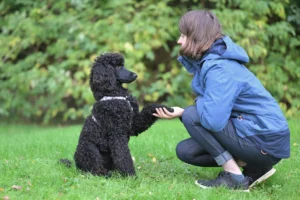
Your Standard Poodle sits at the edge of the training mat, head tilted, watching your hand signal with an intensity that borders on unsettling. She knows what you want—she’s brilliant, after all—but she’s also deciding whether your suggestion is worth her time. This isn’t defiance exactly. It’s negotiation. And if you’ve trained other breeds before, this moment might catch you off guard.
That’s the thing about many hypoallergenic dogs that nobody mentions in those “Best Dogs for Allergies” listicles. The very traits that make them low-shedding often coincide with intelligence levels, energy requirements, and temperamental quirks that require more sophisticated training methods. A Golden Retriever might happily repeat a sit-stay drill fifteen times for a pat on the head. Your Portuguese Water Dog? She’s already three steps ahead, wondering why you’re still stuck on yesterday’s lesson.
Understanding these distinctions isn’t just about getting better obedience. It’s about building a relationship with a dog whose cognitive complexity demands more from you as a trainer and partner.
Why Allergy-Friendly Breeds Demand Different Training Approaches
The correlation isn’t accidental. Many popular low-shedding breeds were developed for specialized work that required independent thinking and sustained focus. Poodles retrieved waterfowl in freezing conditions, making split-second decisions. Portuguese Water Dogs herded fish into nets and retrieved broken tackle. Schnauzers guarded farms and ratted barns. These weren’t tasks you could accomplish by blindly following commands.
That working heritage translates directly to your living room. When your Soft Coated Wheaten Terrier ignores your recall command, she might genuinely be evaluating whether the squirrel scent trail is more important than your request. Her ancestors had to make judgment calls in the field, and that decision-making capacity is hardwired.
This independence shows up in training sessions as selective hearing, creative problem-solving (often not in your favor), and a frustrating ability to distinguish between “real” commands and practice runs. I’ve watched a Miniature Schnauzer perform flawless obedience sequences at home, then completely dismantle the same routine at class because she determined the environment had changed the rules.
Reading the Unique Body Language of Low-Shedding Breeds
Without the visual buffer of a thick double coat, many allergy-friendly breeds display body language more subtly than their fluffier counterparts. A Portuguese Water Dog’s stress signals might register as a slight tightening around the eyes rather than the obvious tucked tail and lowered posture you’d see in a Collie.
Pay attention to ear position shifts that last only two or three seconds. Watch for tongue flicks that happen during transitions between exercises. Your Bichon Frise might show overstimulation through increasingly frenetic movement rather than the shutdown response typical of some other breeds.
Coat Texture and Tactile Sensitivity
The curly, wiry, or silky coats that trap dander instead of releasing it also create different tactile experiences for these dogs. Many develop heightened sensitivity to touch, which directly impacts training methods that rely on physical guidance or correction.
A leash pop that might redirect a Labrador could genuinely startle a Maltese, creating anxiety rather than understanding. Conversely, some wire-haired breeds like the Irish Water Spaniel have such dense coats that they barely register gentle touch cues. You’ll need to calibrate your physical communication with precision, testing different pressure levels during low-stakes training moments.
Motivation Systems That Actually Work
Food motivation varies wildly among these breeds, and not always in predictable ways. I’ve met Labradoodles who’d sell state secrets for a single kibble and others who’d sniff a premium freeze-dried liver treat, then walk away to investigate a dust mote.
The solution isn’t finding one magical reward. It’s building a varied reinforcement menu and reading your dog’s state in real-time. Your Standard Poodle might work brilliantly for toys during morning sessions when her energy is high, but need food rewards during evening training when she’s calmer. A Yorkshire Terrier might require social praise as the primary motivator, with treats as occasional bonuses rather than the main currency.
Here’s what works across most allergy-friendly breeds:
- Rapid reward rotation: Switch between three different treat types within a single five-minute session to prevent boredom and habituation
- Life rewards: Access to sniffing, brief play breaks, or permission to investigate something interesting often outperforms food for intelligent breeds
- Task completion satisfaction: Many of these dogs genuinely enjoy solving problems—the work itself becomes rewarding when structured correctly
- Strategic unpredictability: Intermittent reinforcement schedules (rewarding randomly rather than every correct response) create stronger behavior chains than constant treats
- Social access: For people-oriented breeds like Havanese, proximity to you or release to greet someone can be more valuable than any physical reward
Managing the Energy Paradox
Here’s the contradiction that trips up most owners: many hypoallergenic breeds need substantial physical exercise but relatively brief training sessions. A Soft Coated Wheaten Terrier might need a 45-minute run, but trying to drill obedience for more than eight minutes straight will result in a dog who starts offering every behavior she’s ever learned in rapid succession, hoping something sticks so she can leave.
This isn’t attention deficit. It’s mental saturation. These breeds process information quickly and become frustrated by repetition that feels pointless. The solution is structured variety within consistent frameworks.
The Three-Exercise Rotation Method
Instead of twenty sit-stay repetitions, cycle through three different exercises—maybe sit-stay, down-at-a-distance, and heel position—doing three to five reps of each before rotating. This maintains engagement while still building the repetition needed for muscle memory and impulse control.
Keep total training time under ten minutes for most sessions, but increase frequency. Three five-minute sessions throughout the day will yield better results than one twenty-minute marathon that leaves your Miniature Schnauzer mentally checked out and you frustrated.
Socialization Considerations for Sensitive Breeds
The lower-allergen dog world includes some remarkably sensitive souls. Breeds like the Chinese Crested and certain Poodle lines can develop anxiety-based behaviors if socialization happens too intensely or without adequate recovery time between exposures.
Traditional puppy socialization advice often pushes for maximum exposure—different people, places, surfaces, sounds, all crammed into those critical early months. But a Coton de Tulear puppy might need 48 hours to process a single busy park visit, while a Labrador puppy could handle three different environments in one day.
Watch for signs your dog needs processing time: decreased appetite, disrupted sleep, reluctance to engage in normally enjoyable activities, or hypervigilance that persists for hours after an outing. These indicate you’re moving faster than your individual dog can integrate new experiences.
Adjust your timeline accordingly. Quality matters more than quantity. Five calm, positive exposures to novel situations create better long-term confidence than fifteen overwhelming experiences that teach your dog the world is unpredictable and scary.
Problem-Solving Behavior Challenges Specific to These Breeds
Barking, resource guarding, and separation anxiety manifest differently across allergy-friendly breeds, often with roots in their original purposes. Terrier-type hypoallergenic breeds (Kerry Blue, Bedlington, Wire Fox) were bred to alert and independently engage threats. That means their barking often has a self-reinforcing quality—they bark because the act itself feels necessary and correct, not because they’re seeking your attention or trying to manipulate you.
Addressing this requires redirecting the underlying drive rather than simply punishing the noise. Teaching a “guard time is over” cue, providing appropriate outlets for vigilance behavior (controlled watching from a designated spot), and building incompatible behaviors (holding a toy eliminates barking) work better than corrections that create conflict without changing motivation.
The Intelligence Tax
Smart dogs invent creative problems. Your Poodle mix might develop elaborate rituals around doorways, deciding she can only exit if she’s circled twice and touched the doorframe with her nose. A Portuguese Water Dog might become selectively deaf to certain commands depending on what room you’re in, having noticed that “come” issued from the kitchen usually precedes something unpleasant like nail trims.
These aren’t dominance plays or spite. They’re pattern recognition running wild without proper structure. The fix involves deliberately disrupting these patterns before they solidify—varying your routines, practicing commands in random locations and sequences, and never allowing a behavior chain to become so predictable that your dog starts anticipating and modifying it.
Advanced Skill-Building for Mental Satisfaction
Basic obedience barely scratches the surface of what these breeds can accomplish. Once your allergy-friendly companion has mastered sit, down, stay, and come, their real education begins. This is where you’ll find the greatest training satisfaction and solve many behavioral issues that stem from understimulation.
Scent work translates naturally for many of these breeds. Start with simple find-it games using treats hidden in cardboard boxes, then progress to specific scent discrimination. I’ve seen Lagotto Romagnolos (truffle hunters by heritage) and even Bichon Frises develop reliable scent detection for everything from lost keys to essential oils within three weeks of consistent training.
Object discrimination and retrieval builds impulse control while exercising problem-solving abilities. Teaching your Standard Poodle to retrieve specific items by name—”bring the remote,” “find your leash,” “get the red ball”—provides mental engagement that translates to calmer household behavior.
- Start with two highly distinct objects (a rope toy and a ball), naming each clearly during play sessions over three to five days
- Place both items visible on the floor, ask for one specifically, and reward heavily when your dog investigates or mouths the correct item
- Shape toward full retrieval over the next week, only rewarding when your dog brings the named item to hand
- Add complexity gradually—more similar objects, items partially hidden, requests from different rooms
- Maintain the skill by incorporating real-life usefulness (fetching specific toys, bringing you household items)
Building Reliability in Distraction-Heavy Environments
The controlled perfection of your living room rarely transfers seamlessly to the chaos of a dog park or busy street. Allergy-friendly breeds, with their acute awareness and rapid processing, often struggle more with environmental distractions than some mellower breeds.
Your training needs to systematically increase difficulty along multiple dimensions simultaneously. Distance from you, duration of the behavior, and distraction level form the three Ds of reliability—but most people advance all three at once, setting their dogs up for failure.
Instead, increase only one variable per session. If you’re adding distance (asking for a down-stay from fifteen feet instead of five), keep duration short (just three seconds) and distractions minimal (quiet room, no other people or dogs). Once your Miniature Schnauzer can hold a down-stay at fifteen feet for three seconds in a quiet room with 90% success over three sessions, then you can extend duration or add mild distractions—but not both.
This methodical progression feels slow. It is slow. It’s also the difference between a dog who sometimes recalls at the park and one who reliably responds even when squirrels are involved.
Conclusion: Training as Relationship-Building
The most successful training relationships with hypoallergenic dogs happen when you stop viewing sessions as obedience drills and start seeing them as conversations. Your Portuguese Water Dog isn’t being stubborn when she pauses before complying—she’s processing, deciding, engaging her full cognitive capacity with your request.
This might mean longer timelines than you’d experience with more biddable breeds. A Golden Retriever might proof a reliable recall in six weeks. Your Poodle might need twelve, not because she’s slower to learn but because she’s constantly evaluating context, testing boundaries, and making independent decisions about when compliance serves her interests.
That independence, properly channeled through patient and thoughtful training, creates a companion whose responsiveness comes from genuine partnership rather than rote obedience. The effort compounds. Every session that respects your dog’s intelligence and working heritage builds trust that makes the next session more productive.
Start where you are. Pick one concept from this guide—maybe reward variety, or shorter training sessions, or systematic distraction proofing—and implement it this week. Watch how your allergy-friendly companion responds when training finally matches her capabilities.
Related Articles
- Can Dogs Eat Apples? A Complete Safety Guide for Pet Owners
- Can Dogs Eat Bananas? A Complete Guide for Pet Owners
- Advanced Training for Great Pyrenees: Master Their Independence
- Anatolian Shepherd Advanced Training: A Complete Guide
- Advanced Training for Great Danes: Building a Gentle Giant
Frequently Asked Questions
Are hypoallergenic dogs harder to train than other breeds?
Not harder, but different. Many allergy-friendly breeds rank among the most intelligent dogs, which means they learn quickly but also bore easily and may question repetitive commands. They often require more creative training approaches and mental stimulation than simply drilling basic obedience. The challenge isn’t their ability to learn—it’s keeping them engaged and working with rather than against their independent thinking.
How long should training sessions last for low-shedding breeds?
Most hypoallergenic breeds perform best with sessions lasting five to ten minutes, repeated two to four times daily rather than one long session. These intelligent dogs process information rapidly and become mentally fatigued or frustrated with extended repetition. Brief, frequent sessions maintain engagement and allow time for mental processing between training periods, leading to better retention and more reliable responses.
Do all hypoallergenic dogs have similar training needs?
No—the category includes diverse breeds with vastly different temperaments and drives. A high-energy Portuguese Water Dog has completely different needs than a companion-focused Maltese, even though both are considered allergy-friendly. Research your specific breed’s working heritage and original purpose, as these strongly influence training approach, motivation, and the types of activities that will satisfy them mentally and physically.
Why does my Poodle ignore commands she clearly knows?
Intelligent breeds often demonstrate selective compliance based on context evaluation. Your Poodle isn’t being spiteful—she’s likely noticed patterns where certain commands lead to outcomes she’d rather avoid, or she’s determined that environmental factors have changed the rules. This requires proofing commands in varied contexts and ensuring compliance always leads to worthwhile outcomes from your dog’s perspective, not just yours.
What’s the best first advanced skill to teach an allergy-friendly dog?
Object discrimination and retrieval by name provides excellent mental stimulation while building impulse control and focus. Start by teaching your dog to differentiate between two distinctly different toys, rewarding when she brings the specifically named item. This skill engages problem-solving abilities, has practical household applications, and can expand infinitely as your dog masters the concept, keeping training fresh and challenging for years.